
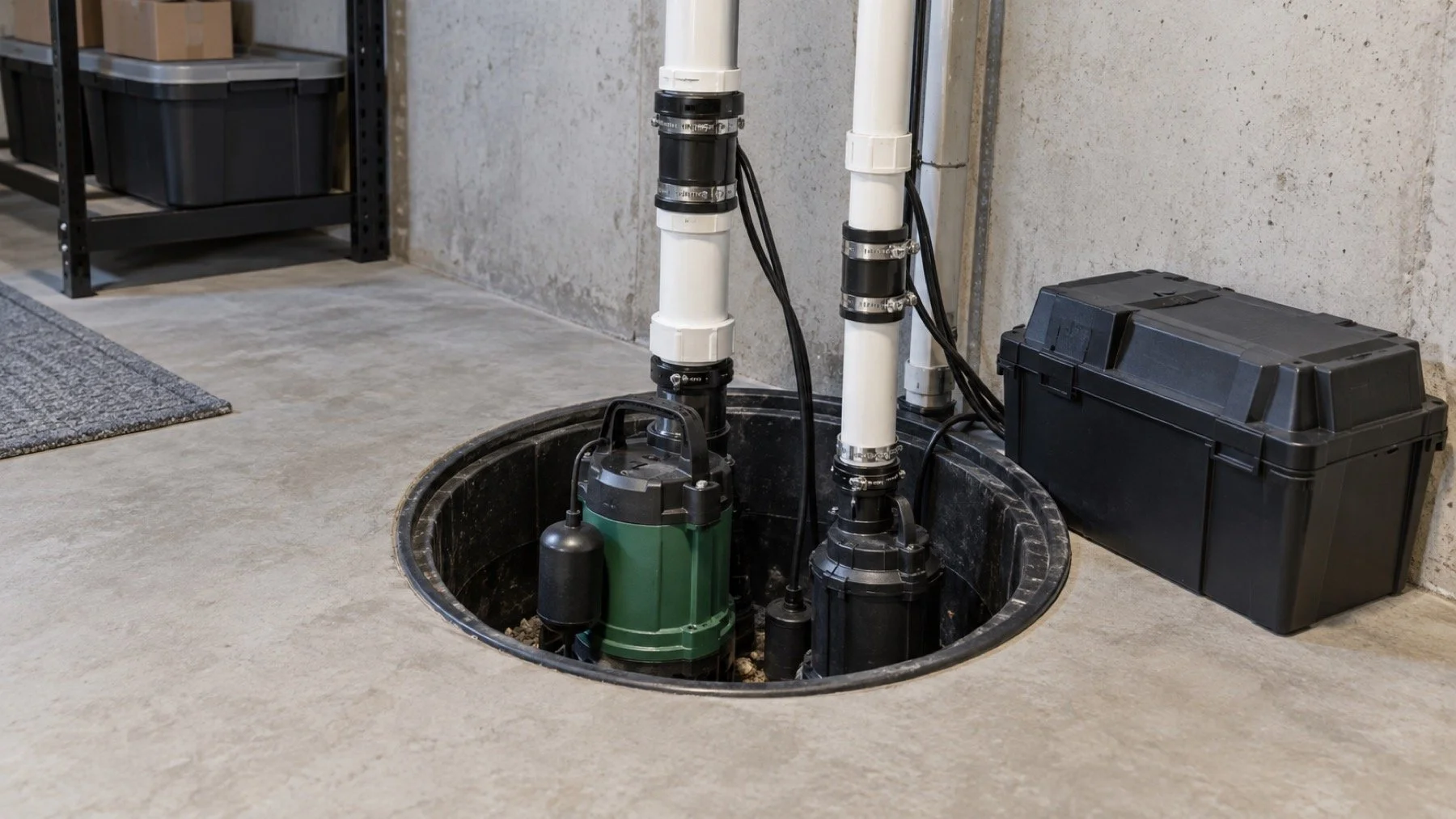
The storm that sends water into a sump pit can also interrupt power. A primary pump connected only to household electricity cannot move water during that outage, even if the pump itself is in good condition.
A sump pump only protects the basement while it has power, so the pit needs a battery backup, a water powered backup or a generator circuit planned for it before the space is finished.We plan backup from the pit demand, discharge route, available water service, electrical arrangement, alarm needs, and access for testing. A battery unit, water powered pump, and generator supplied circuit solve the power gap in different ways. None guarantees that a basement will never flood.
This comparison helps a GTA homeowner choose the questions that matter before the basement is finished around the pit.
Battery backup adds a separate pump and stored power
A typical battery backup uses a secondary pump, controller, charger, alarm, and battery. It can operate without municipal water, but its performance depends on the selected pump, the battery condition, the lift, and how often it cycles. Do not accept a runtime promise that ignores those variables.
The battery needs a dry, reachable location and regular testing. Record the exact replacement and maintenance instructions from the manufacturer.
Water powered backup trades electricity for water flow
A water powered backup uses municipal water pressure to move sump water. It has no battery to charge, but it consumes potable water and requires an approved plumbing arrangement with backflow protection as applicable. It also depends on the water service remaining available during the event.
Confirm whether the property, local rules, service size, and discharge route make this option appropriate. It is not a universal replacement for a battery system.
A generator plan includes more than owning a generator
A portable or standby generator may power the primary pump if the electrical design, connection method, fuel, placement, and operating procedure are suitable. Seal Plumbing does not perform electrical work. Anyone you hire for electrical work in Ontario must be a Licensed Electrical Contractor.
A homeowner doing their own electrical work in a home they own and live in must file the required ESA notification. Coordinate that work with the Electrical Safety Authority process and the selected equipment instructions.
The discharge path still has to work
Backup power cannot overcome a frozen, blocked, disconnected, or undersized discharge. Inspect the visible pipe, check valve, exterior outlet, and route. Make sure both pumps can discharge without forcing water back into the pit.
A shared discharge needs a design that prevents one pump from interfering with the other. Keep valves and unions accessible after finishes are installed.
Test failure modes, not only the normal cycle
Test the primary pump, then follow the manufacturer procedure to simulate the event that starts the backup. Confirm the alarm is audible where people will notice it. Record which breaker, battery, water valve, or generator connection belongs to the system.
Repeat testing at the interval in the product instructions and before seasons with heavier inflow. Replace consumable parts based on verified condition and manufacturer guidance, not a generic promise.
Compare backup systems under real conditions
Size the backup from the pit, lift, and inflow
Backup capacity should be compared at the actual vertical lift and discharge conditions, not only by a large number on a product label. Measure the pit, the distance to the outlet, pipe size, fittings, and observed inflow during wet conditions. A system that moves enough water in a shallow test may deliver less through a longer or higher route.
Observe the primary pump cycle before selecting the secondary system. Record how quickly the pit fills, how far the level drops, and whether water returns after shutoff. Heavy inflow, a restricted discharge, a failed check valve, or an undersized pit can shorten the time available during an outage. Backup planning should not hide a problem in the primary arrangement.
Set the backup activation level so it responds when the primary cannot keep up or cannot run, while preserving freeboard below the inlet and floor. The exact setup follows the selected product and pit geometry. Two floats crowded against pipes can interfere with one another, so verify movement through the full water level range.
Compare power sources by their failure conditions
A battery system stores energy on site and normally uses a dedicated secondary pump, charger, controller, and alarm. Runtime varies with battery condition, pump load, cycling, and inflow. Ask for performance information at the real installation conditions and a maintenance procedure. A simple hours claim without those conditions can mislead a homeowner.
A water powered backup uses municipal water pressure and an approved plumbing arrangement to move sump water. It avoids battery charging but consumes potable water and depends on the municipal supply remaining available. Service size, pressure, backflow protection, discharge design, and local requirements all need review. It is not appropriate for every property.
A generator can support the primary pump when the electrical plan and operating procedure are suitable. Seal Plumbing does not perform electrical work. In Ontario, anyone hired to do electrical work must be a Licensed Electrical Contractor. A homeowner doing work in a home they own and live in must follow the Electrical Safety Authority notification requirements. Coordinate that scope rather than improvising a connection during a storm.
Make the alarm and test routine part of the installation
An alarm only helps when someone can hear or receive it. Test sound levels with doors closed and mechanical equipment running. If a connected notification system is selected, verify what happens when internet or house power is lost. Record the alarm condition that means high water, low battery, charger trouble, or pump operation so the owner can respond correctly.
Test the system through the manufacturer procedure for primary failure, not by randomly unplugging equipment around water. Confirm the backup starts, the pit level falls, the discharge remains secure, and the alarm communicates. Then restore the normal configuration and verify the charger or water valve status. Keep the test steps beside the equipment in plain language.
Before finishing the basement, preserve access to both pumps, floats, check valves, unions, battery or water control, and the pit cover. A decorative cabinet that requires demolition for a battery change is not useful access. Plan a dry service area, lighting, and a route for removing equipment without crossing finished furniture or storage.
A backup plan also needs an outage plan
Write down who checks the basement during an outage, where the alarm can be heard, how the battery condition is displayed, and what action follows a high water alert. If the household may be away, decide whether local monitoring is enough or whether a verified remote notification system belongs in the project. Test that notification under the same loss of power or internet it is meant to survive.
Keep an unobstructed route to the pit and equipment. Store nothing on the cover, battery enclosure, valves, or power connections. Post the plumber, electrician when applicable, restoration contact, and utility information in a dry location. The goal is to shorten the time between an abnormal water level and a safe response.
After a real outage or high water event, inspect and test both pumps before returning to routine. Record how long the backup operated, any alarms, water levels, and whether the discharge remained clear. That event history is better evidence for future capacity decisions than a generic product runtime printed under different conditions.
Choose the backup with the service record open
Bring the primary pump model, pit measurements, discharge route, power arrangement, observed cycle during wet weather, and any prior alarm or outage history. Product comparison becomes more meaningful when each option is checked against the same lift, inflow, access, and maintenance conditions.
Ask the proposal to name what happens when the primary loses power, when it fails mechanically, when the discharge blocks, and when inflow exceeds capacity. One backup may not address every condition. The finished scope should say which failures it covers, which it does not, and how the owner tests the installed system.
Make testing part of ownership
Backup equipment earns its place through testing. The owner should be able to identify the primary pump, backup pump, alarm, power or water source, discharge, and service access. A labelled and tested arrangement is easier to trust than a second pump that has never been observed under a failure condition.
Battery location deserves the same care as the pump. Keep it dry, supported, ventilated as the product requires, and protected from impact while preserving access to terminals, indicators, and replacement space. Do not hide it behind stored boxes or finished panels. Record the battery specification and installation date without inventing a replacement interval. Inspection, testing, and manufacturer guidance should determine service. A battery that looks present but cannot be checked does not provide a dependable maintenance plan.
Treat backup pumping as part of basement protection
A backup belongs beside the primary pump, discharge, and wider basement protection plan.
Toronto advises that the sump pump outlet should discharge onto a permeable surface at least 2 metres from the foundation wall. Toronto sump pump and battery subsidy details.
Code aware next step for outage planning
Send pit dimensions, pump labels, discharge photos, and the basement finishing plan. Seal Plumbing can assess the plumbing side of a backup arrangement and coordinate the boundaries with electrical work.