
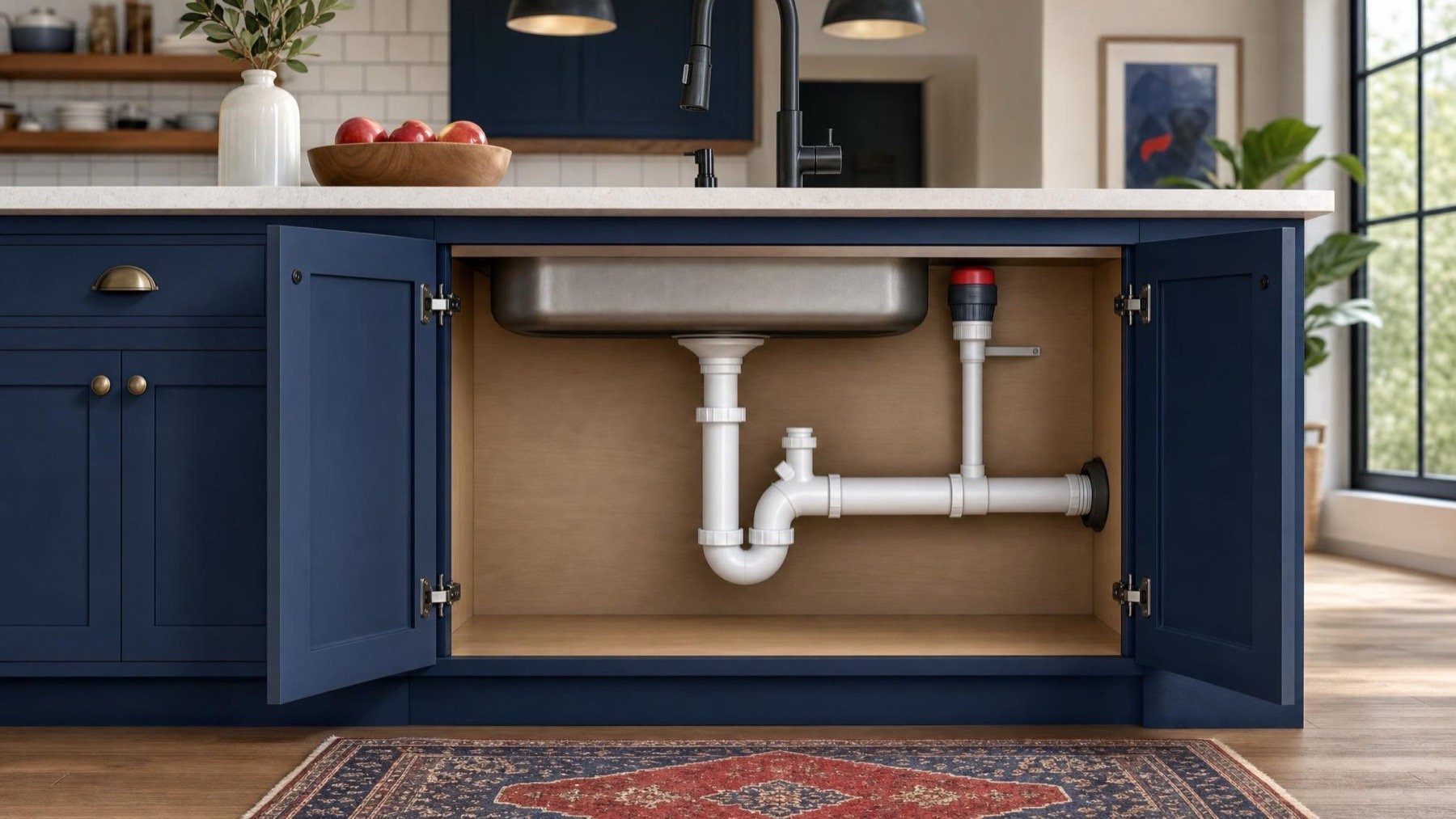
An island sink has no wall above it, so where does its vent go? An air admittance valve can vent an island sink or remote fixture without a new roof pipe, but the building still needs a main stack vent and local acceptance must be confirmed before the layout depends on it. Used in the right place, it saves running a new vent through finished walls. Used in the wrong place, it fails inspection or leaves a drain that gurgles and smells.
This guide explains how the valve works, where it fits in a Toronto or GTA renovation, and what to settle with your inspector before cabinets are ordered.
What the valve does
Every drain needs air behind the water so the trap is not siphoned dry. A conventional vent is an open pipe that rises through the building and out the roof. Manufacturer guidance describes an AAV as a one way mechanical vent that can let air into the drainage system without a roof penetration. When water stops flowing, the valve closes and keeps sewer gas out of the room.
The same guidance notes that a building generally still needs at least one traditional stack vent through the roof. An AAV supplements the vent system and leaves the main stack in place. Oatey's AAV guide sets out the installation limits in more detail.
Where the valve helps in a renovation
The most common case is an island sink. With no wall above the sink, there is nowhere to run a vent pipe upward. Older approaches loop the vent under the cabinet and floor, which takes space and careful routing. A valve in the sink cabinet simplifies the layout where it is accepted.
Other cases include a bar sink in a finished basement, a laundry sink far from the stack, or a fixture added where the existing vent is buried behind finished walls.
An island sink needs proper drain and vent routing under the floor, which we plan and rough in before cabinets. Our kitchen rough in page covers that work.
Installation details that matter
Manufacturer instructions typically call for the valve to sit above the flood level rim of the fixture it serves and stay accessible for inspection. In a sink cabinet, that means the valve sits high on the drain line inside the cabinet, with no panel or drawer box sealed over it.
The valve also needs air around it. A valve sealed inside a closed wall cavity cannot breathe and cannot be checked. If it sits in a wall, plan an access panel or grille. Size matters too, because valves are rated for a drainage load and an undersized valve falls behind the fixtures it serves.
Who decides whether it is allowed
Acceptance varies by jurisdiction, so the local building department and the applicable code govern where an AAV may be used. In Ontario, enforcement of the Building Code is generally the responsibility of municipal building officials. The current edition is on the province's Building Code page. Toronto's permit page notes that a stand alone plumbing permit can cover work not related to other construction proposed for a building. The City's plumbing and drain permit page lists the documents.
Renovation plumbing should be planned before walls and finishes lock in the layout, and venting is a clear example. Raise the valve during design, not at inspection. If the inspector expects a conventional vent and the cabinets are already installed, the correction means opening the floor.
Older Toronto homes need proper rough in planning to tie new fixtures into existing supply and drainage. A buried vent is often part of that puzzle. Our Toronto plumbing page covers that work.
Plumbing questions from GTA renovations
Can I use an AAV for a toilet?
Whether a valve can vent a toilet comes down to its rating and the code that applies to the building. Toilets move a large volume of water, so the valve has to be rated for the load and the installation has to be accepted locally. Ask before the layout depends on it.
Do AAVs require maintenance?
Most valves need little attention, but they are mechanical parts that wear or stick over time. Keep the valve reachable, watch for sewer odour near it, and listen for gurgling drains, which point to a valve that is not opening. Replacement is simple when the valve stays accessible.
Code aware next step
Send the kitchen or basement layout, where the new sink will sit, and what is below the floor. We will tell you how the drain and vent can be routed and what to confirm with the inspector.
Send Seal Plumbing the project details through our contact page.